
Booking appointments with an AI agent. Why it can take over most of your phone line and often does it better than a person
For most of the day, the phone line of a clinic, school or service centre does one thing: it looks for a free slot that suits the caller. A patient wants “as soon as possible, but not on Thursday”, a parent wants “Saturday morning, for two kids”. The human agent clicks through schedules while the queue grows. An AI agent searches the same systems in a second or two, immediately suggests another city, a teleconsultation or next week, and books the slot during the call. We show why such an agent can take over around 70% of calls and when it should hand the case to a person.
In short
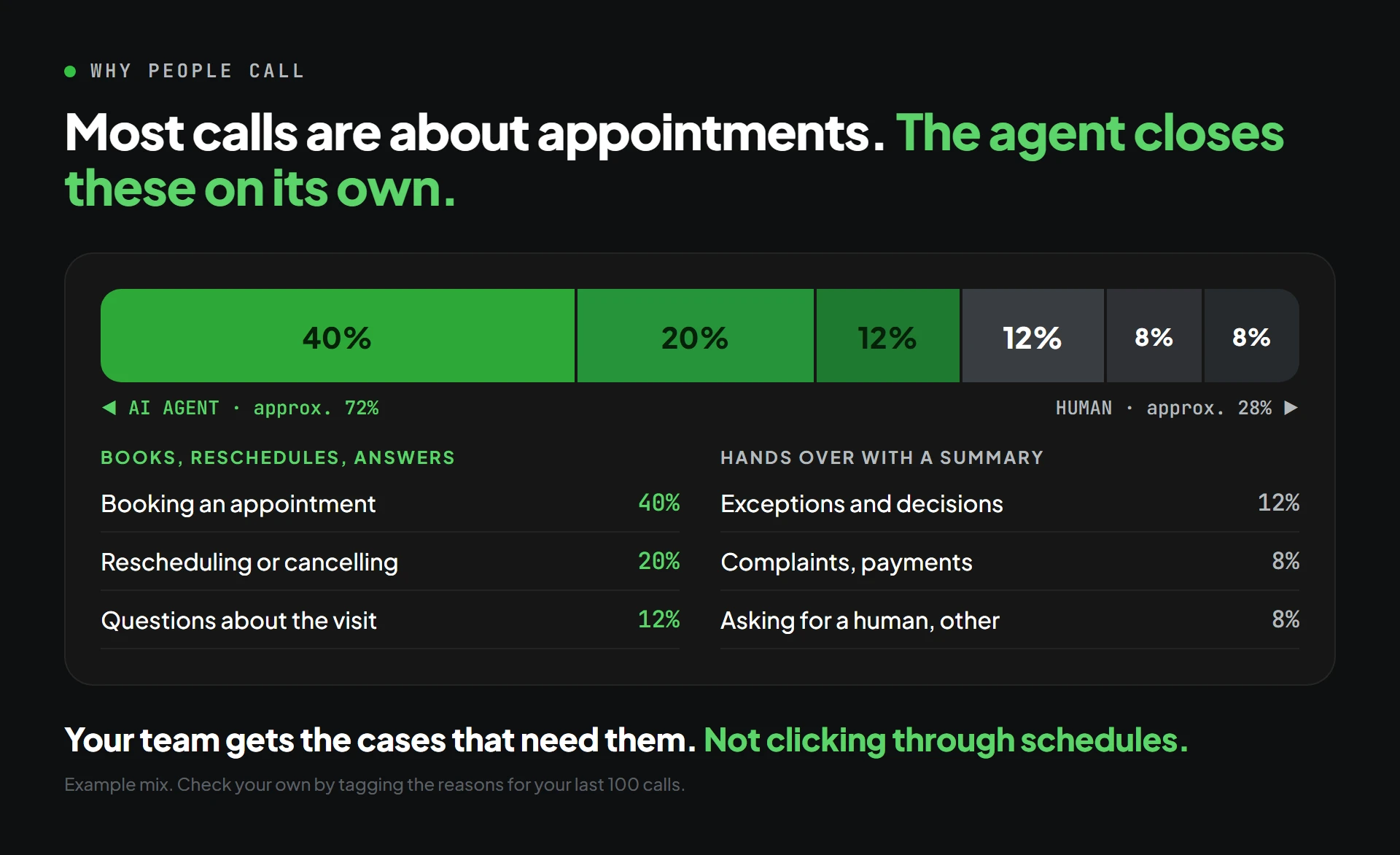
- Most calls to a phone line are about appointments: booking, rescheduling, cancelling and questions about the visit. These cases are repetitive, have a clear goal and a system that knows the answer. That is why an AI agent can take over around 70% of calls. You can check your own share by looking at your breakdown of call reasons.
- The agent does not take a "we'll call you back" request, it books. It checks free slots in the booking system, books the appointment and sends an SMS confirmation or a payment link.
- When negotiating a slot, it is often better than a person. It searches the schedules of every location in a second or two and immediately offers alternatives: a nearby city, a teleconsultation, next week, a different service.
- Hard cases reach people with context: exceptions to the rules, complaints, cases that need a decision and every clear need to talk to a person. The human agent gets a summary instead of starting from scratch.
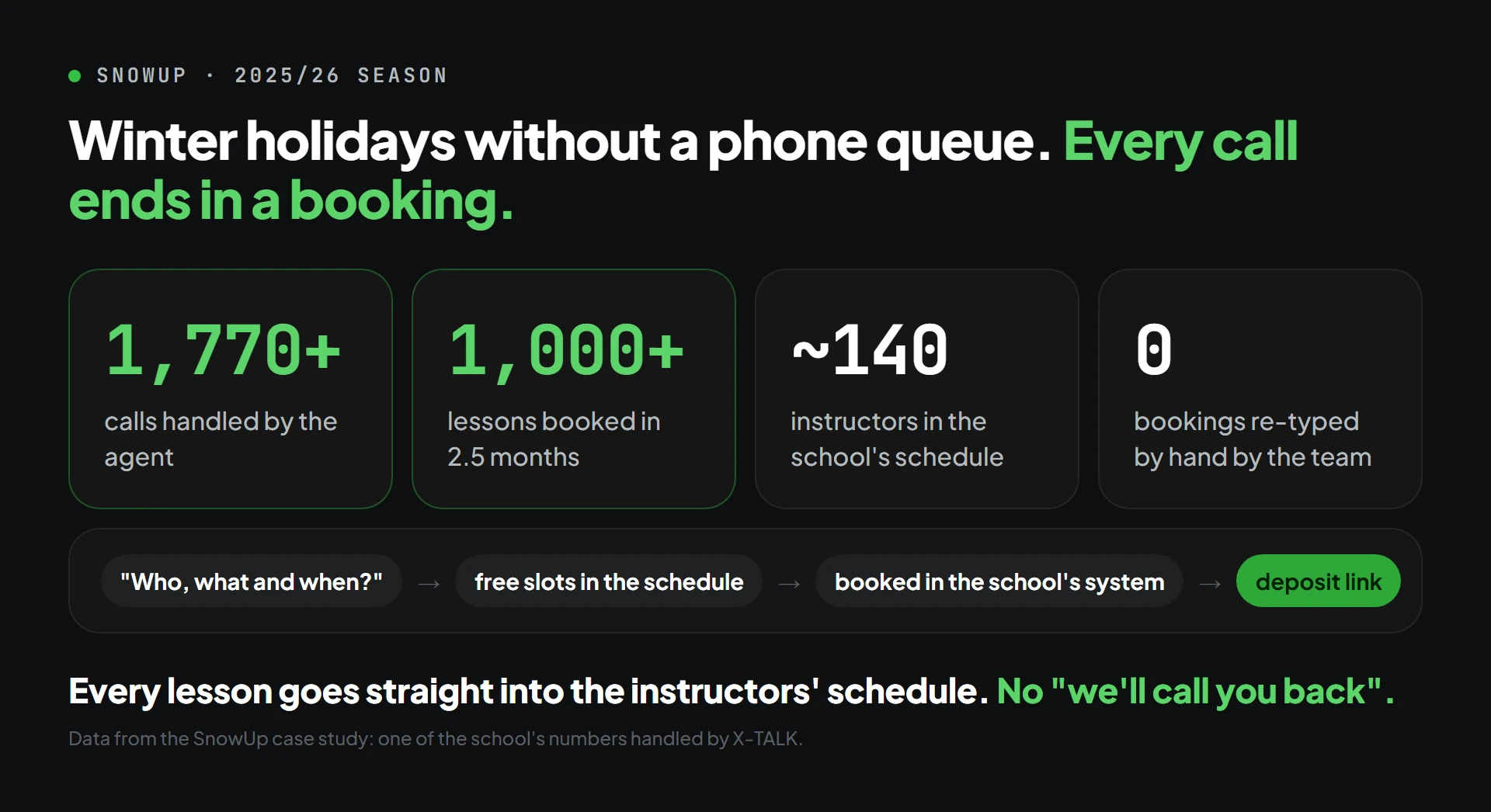
- It works in production. In the 2025/26 season, the SnowUp ski school handled more than 1,770 calls with X-TALK and booked more than 1,000 lessons in 2.5 months. In a proof of concept for two clinic networks, the agent picked the specialism, the visit type and real slots from their systems.
Why does booking appointments put so much pressure on a phone line?
Because it is a conversation that looks simple but in practice involves several steps and several systems. A caller rarely says "I'd like 14 March at 10:20, please". They are more likely to say:
“I need a dermatologist, ideally next week after work. I live in Toruń, but I can get to Bydgoszcz.”
The human agent has to establish the service, check the schedule at one clinic, then at another, rule out slots before 4 pm, look through the following week and, when nothing fits, suggest something else. Every "no, that doesn't suit me" starts the search again. The call lasts several minutes, and on a Monday morning there are dozens of such calls at once.
On top of that come reschedules and cancellations, which take as long as a booking but do not bring in a new appointment. When nobody takes them, because the line is busy or it is after hours, the freed slot is lost and the patient simply does not show up.
How many calls can an AI agent take over, and where does the 70% come from?
The 70% figure does not come from a promise but from the structure of calls. If you break down why people call a clinic, school or service centre, a similar picture usually emerges:
| Call reason | Can the agent close it on its own? |
|---|---|
| Booking an appointment, lesson or service | yes: it picks the service and slot and books it |
| Rescheduling or cancelling | yes: it frees the slot and offers a new one straight away |
| Questions about the visit: price, address, hours, preparation | yes: from the knowledge base, in the same call |
| Confirming tomorrow's appointment | yes, including in outbound calls |
| An exception to the rules, e.g. a visit outside the schedule | no: it needs a person's decision |
| A complaint or payment dispute | no: handover with a summary |
| A case not covered by the procedures | no: a ticket or a human agent |
The first four rows usually account for a clear majority of calls. They are not easy for people, because they require clicking through several schedules, but they are easy to describe with rules. This is exactly the kind of work where the agent is strongest.
Your share may be higher or lower. The simplest way to check it: take your last 100 calls, assign a reason to each one and count how many end with a slot in the system without a person's decision. We describe how to do this step by step in our article Intent map: where to start customer service automation.
Why does an agent often negotiate a slot better than a person?
Because negotiating a slot is essentially a search with conditions, and the agent searches systems faster and more widely than the browser tabs of a human agent allow.
It looks at all the options at once. A human agent usually checks one clinic and one week, because there is no time for more during a call. The agent asks the system about several locations, several days and several visit types in one step, and then picks the best matches itself. A query to the booking system usually takes a fraction of a second, and the whole answer with a suggestion takes a second or two.
It suggests alternatives itself. When there is no slot "on Thursday after 4 pm in Toruń", the agent does not say "unfortunately, nothing is available". It immediately offers the closest sensible options:
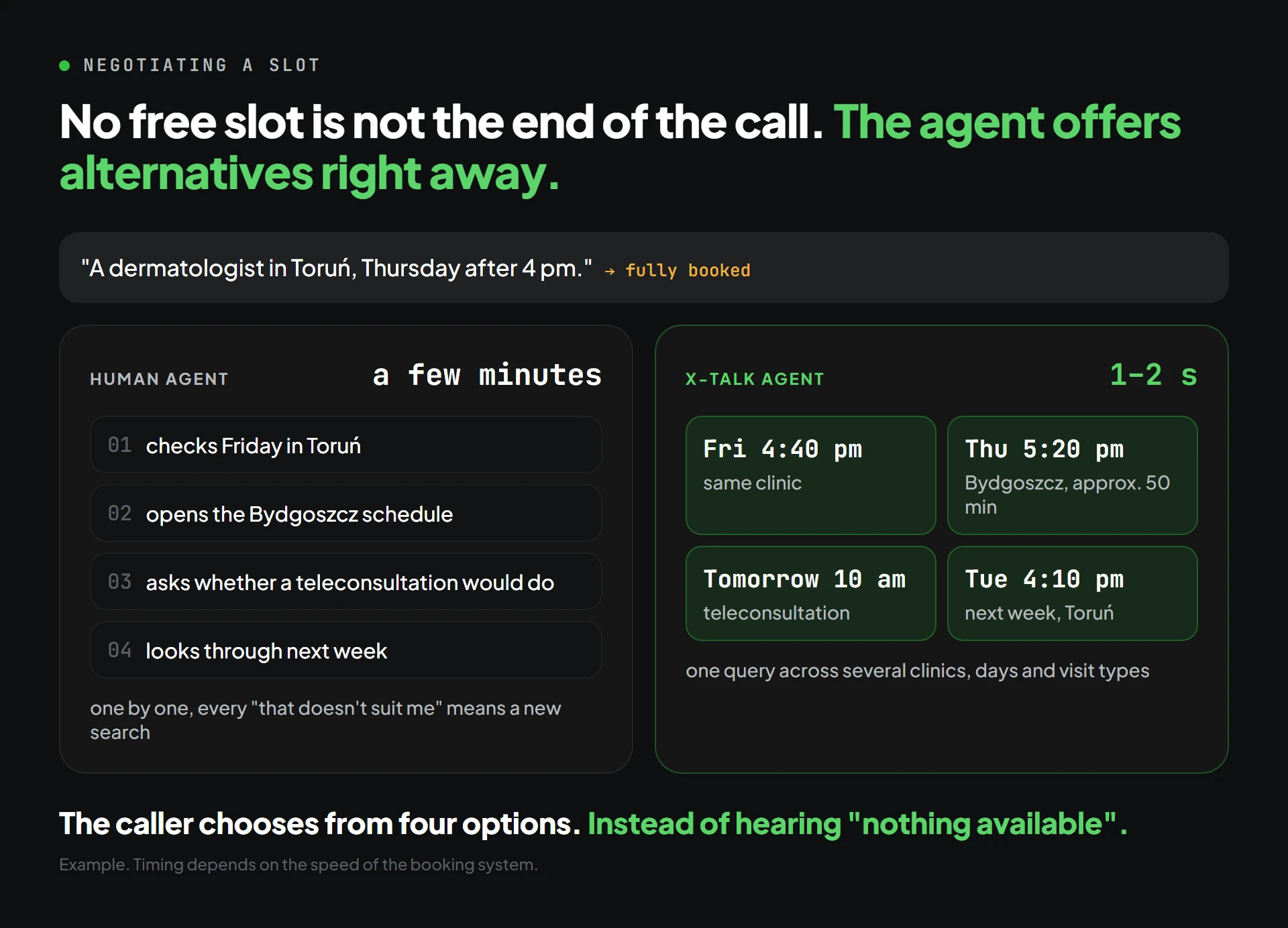
- another day at the same clinic: "Friday at 4:40 pm is free",
- a nearby city: "In Bydgoszcz I have Thursday at 5:20 pm, about 50 minutes away",
- a teleconsultation, if the service allows it: "I can book a teleconsultation tomorrow at 10 am",
- next week: "The nearest is Tuesday at 4:10 pm in Toruń",
- a different service or specialist, when it makes sense: a GP instead of a specialist for a first visit, group lessons instead of private ones.
It remembers the conditions from the whole call. "Not on Thursday", "after work", "for two kids" do not get lost after the third question. The agent does not suggest Thursday again once the caller has turned it down.
It does not get tired or cut corners. The hundredth call on a Monday morning gets as many options as the first. There is no queue pressure pushing it to offer the first free slot and end the call.
We write more about what the agent does in those few seconds, and how it splits one sentence from a customer into several system queries, in our article “Just a moment, I'm checking”: where AI agents answer faster and better than people.
What does it look like in production? The SnowUp ski school
SnowUp runs lessons with around 140 instructors during the winter holidays. For a few weeks the phones never stop ringing; for the rest of the year they go almost silent. You cannot hire and train a team of human agents for a single season, and most callers are parents doing this for the first time who do not know the offer.
The X-TALK agent handled one of the school's numbers. In the 2025/26 season it held more than 1,770 calls and booked more than 1,000 lessons in 2.5 months. It wrote each one directly into the instructors' schedule, in the system the school already uses, and immediately sent a deposit link. The call ended with a slot in the calendar and a payment, not with a promise to get back in touch.
Two lessons from this deployment are useful in any industry:
- One open question instead of a form. At the start, the agent asked questions step by step. After analysing the first calls, the opening changed to: "Tell me who you'd like to book, for what and when, and I'll take care of the rest". People speak in their own way, and the agent works out the age, level and date from that by itself.
- "Put me through to a person" is often a reflex, not a need. Many calls began with this request before the caller said what it was about. The agent does not refuse; it asks what the call is about so it can put them through to the right person. When it is about a booking, it completes it itself. When someone really needs a person, it connects them to a human agent during working hours and takes a callback request outside them.
And in healthcare? A proof of concept for clinic networks
A clinic is a harder case than a school: more specialisms, many locations in different cities, in-person visits and teleconsultations, and on top of that a patient who often does not know which doctor they should book.
In a proof of concept for two clinic networks, the agent worked on real schedules from their booking systems:
- It worked out the specialism from the description. "I've had an itchy rash on my forearms for a few days" led to a dermatologist; "runny nose, sore throat, slight fever" led to an internist. The agent does not diagnose and does not give medical advice. It only helps the patient get to the right clinic.
- It asked about the visit type: in person or a teleconsultation. For a teleconsultation, the city is no longer a constraint, so slots are often sooner.
- It searched across cities, not a single clinic. First the days with free places in a given city, then specific times, doctors and prices.
- It offered real slots. Every suggested slot, doctor and price was confirmed by a separate, independent query to the booking system.
- It finished with a booking or a link to complete the booking online, depending on what the system allowed.
We describe the full range of features for healthcare providers on the For healthcare providers page, and bookings, reschedules and cancellations in other industries on the Bookings page.
Which cases should reach a person?
The goal is not an agent that never transfers. The goal is an agent that closes repetitive cases and hands people the ones where a person is really needed. That is the remaining 30% or so, and for your human agents it is completely different work from clicking through schedules.
| Case | What the agent does |
|---|---|
| An exception to the rules: a visit outside the schedule, an urgent appointment | collects the details and passes them to someone who can decide |
| A complaint or payment dispute | logs a ticket with a description or connects to a human agent |
| A medical question beyond booking | does not answer on substance, refers to the staff |
| A case not covered by the procedures | does not guess, logs a ticket with all the details |
| A clear request for a person after explaining the case | transfers to the right queue with a summary |
"With a summary" is what matters. The human agent does not start with "how can I help?" but sees who is calling, what they are looking for, which slots have already been offered and why they did not suit. If the caller speaks another language, X-TALK translates the conversation live, also after handover. We describe how to design queues and handover conditions in the playbook chapter Routing, queues and handover to a human.
What else does the agent do besides answering calls?
When the agent has access to the booking system, it can also call and write on its own, in matters you decide on:
- it confirms tomorrow's appointments and reschedules them straight away when someone cannot come,
- it sends reminders about the appointment by SMS the day before,
- it returns freed slots to the schedule the moment they are cancelled, not the next morning,
- it handles chat and SMS with the same agent, the same knowledge and the same access to the schedule.
This has a direct effect on the number of missed appointments. A slot that someone cancelled at 9 pm in a conversation with the agent is available to the next patient by morning. We describe outbound calls on the Outbound calls page.
Where should you start with appointment booking by an AI agent?
Ideally with one process and one number, for example bookings for one clinic or handling cancellations. Checklist:
- Break down the reasons for your last 100 calls and count how many end with a slot without a person's decision.
- Check whether your booking system has an API for reading free slots and booking appointments. If not, start with a link to complete the booking online.
- Write down the rules: which services, at which locations, when a teleconsultation is acceptable and which alternatives may be offered.
- Agree on the list of cases that go straight to a person, and the queues they go to.
- Prepare answers to questions about the visit: prices, addresses, hours, preparation.
- Start with the open question "who, what and when", not with a form.
- Test conversations on scenarios with real conditions: "not on Thursday", "for two kids", "I can travel to another city".
- After two weeks, compare the number of bookings, reschedules and missed appointments with the period before launch.
You can build the agent from your website address in the free Copilot, and check conversation scenarios in agent tests. An integration with your own booking system can be added as a custom tool.
Frequently asked questions
Does an AI agent really book the slot, or does it just take a request?
It books, if the booking system allows it. The agent checks free slots, books the appointment and sends an SMS confirmation or a payment link. When the system only allows reading, the agent suggests a slot and sends a link to complete the booking online.
How do you know the agent will take over 70% of calls?
You do not know in advance. 70% is an estimate based on a typical breakdown of call reasons, in which bookings, reschedules, cancellations and questions about the visit make up a clear majority. You can check your own share by assigning reasons to your last 100 calls and then measuring the results of a pilot on one number.
Will the agent suggest a teleconsultation or another location?
Yes, if those options are in the system and in the rules you set. When there is no slot on the chosen day or in the chosen city, the agent immediately offers alternatives: another day, a nearby location, a teleconsultation or the nearest slot the following week.
Does the agent give medical advice?
No. The agent helps the patient get to the right clinic based on their description, but it does not diagnose or recommend treatment. It passes medical questions beyond booking to the staff.
What if the caller asks for a human agent straight away?
The agent asks what the call is about so it can connect them to the right person. It often turns out to be a booking that the agent can make straight away. If the caller really needs a person, the agent connects them to a human agent during working hours or takes a callback request.
How quickly does the agent search for slots?
Usually in a second or two, including several locations and days. It depends mainly on the speed of the booking system. Meanwhile, the agent says a short sentence such as "Checking the available slots", so the line does not go silent.